

Introduction
In an era of market volatility and economic uncertainty, investors constantly seek assets that deliver superior returns while minimizing risk. At Wilper Ventures, we’ve analyzed decades of financial data across multiple asset classes, and the evidence is compelling: strategically located land consistently outperforms traditional investment vehicles like bonds, money markets, and shares.
This isn’t speculation or theory. Hard data from HassConsult, the Central Bank of Kenya, the Nairobi Securities Exchange, and the Kenya National Bureau of Statistics back it. What we’ve discovered is that while most investors chase yields in securities markets, the real wealth-building opportunity has been sitting right beneath their feet—literally.
This comprehensive analysis presents 14 concrete, data-driven reasons why prime land investment—particularly in emerging corridors like Ngong-Kimuka—represents one of Kenya’s most compelling wealth-building opportunities for investors with 5-10 year horizons.a
Reason 1: Superior Historical Returns That Compound Relentlessly
The Numbers Tell an Unambiguous Story
According to HassConsult’s 2024 Land Price Index, satellite towns around Nairobi delivered extraordinary appreciation in a single year:
- Ongata Rongai: 16% appreciation to Ksh 27.4 million per acre
- Syokimau: 15.8% increase to Ksh 33.7 million per acre
- Kiserian: 15.5% appreciation year-over-year
- Mlolongo: 15% growth in 12 months
On an annual basis, land in Nairobi’s suburbs rose by 5%, while satellite towns as a category appreciated by 11.2%. Nine out of fourteen satellite towns posted double-digit annual gains.
But the truly staggering figure emerges when we zoom out: Since 2000, residential property prices in Kenya have surged by 425%—far outpacing the USA (201%), France (151%), and Singapore (122%).
Why This Matters More Than Stock Market Headlines
Compare this to the Kenyan stock market. Yes, the NSE 20 Share Index was up 50% year-over-year as of early 2026, and the market returned approximately 54% in 2024. But this headline masks critical context: these returns followed years of modest performance and significant volatility. The NSE All Share Index regularly experiences weekly swings of 0.83% and four-week movements exceeding 7%, while investors should also consider the performance of shares in the context of overall wealth-building strategies.
For the average investor, stock market returns aren’t determined by index performance—they’re determined by entry timing, exit timing, and whether you panic-sold during inevitable corrections. The 2008 financial crisis saw global equity markets plummet 50-60%, and many Kenyan investors experienced similar drawdowns.
Land’s performance, by contrast, has been remarkably consistent. HassConsult data shows satellite towns maintained their upward trajectory even during economic challenges, with quarterly increases averaging 3% regardless of broader economic headwinds.
The Compounding Effect Over Time
A 13% average annual appreciation (conservative for satellite towns) doesn’t sound revolutionary until you understand compounding:
- Ksh 1 million invested in 2020 in a satellite town, appreciating at 13% annually
- By 2025: Ksh 1.84 million (84% total return)
- By 2030: Ksh 3.39 million (239% total return)
- By 2035: Ksh 6.25 million (525% total return)
Compare this to money market funds averaging 11% after-tax returns over the same period, which would grow Ksh 1 million to only Ksh 1.69 million by 2025—less than half the land investment return.
Key Insight: Land doesn’t just deliver superior returns in exceptional years. It delivers superior returns consistently, year after year, creating a compounding advantage that dramatically widens the wealth gap over time.
Reason 2: Volatility is Wealth-Destroying—Land Eliminates It

Most investors focus on average returns while ignoring volatility’s devastating impact on actual wealth accumulation. Consider two investments:
Investment A (Stocks): Returns of +30%, -20%, +25%, -15%, +20% over five years
Investment B (Land): Returns of +13%, +13%, +13%, +13%, +13% over five years
Both have similar average annual returns of around 8-10%. But Investment A (volatile stocks) turns Ksh 1 million into approximately Ksh 1.45 million after five years, while Investment B (stable land) produces Ksh 1.84 million—a 27% difference in final wealth despite similar average returns.
Why? Because losses hurt more than gains help. A 50% loss requires a 100% gain just to break even. Volatility isn’t just psychologically stressful—it’s mathematically wealth-destroying.
Land’s Remarkable Price Stability
Even during Kenya’s most challenging economic periods—the 2008 global financial crisis, COVID-19 pandemic, 2022-2023 inflation spike—land prices in prime satellite towns exhibited extraordinary resilience. According to HassConsult, while growth rates may have moderated during crises, actual price declines were virtually non-existent in strategically located areas.
During the 2023 period, when construction input costs surged and credit became expensive, satellite towns still posted quarterly appreciation averaging 3%. Properties might plateau temporarily during severe economic stress, but they maintain value and quickly resume appreciation once conditions normalize.
The Sleep-Well-At-Night Test
Stock market investors wake up to potential 5-10% portfolio swings on any given day. Land investors wake up knowing their asset’s value is essentially unchanged from the previous day—and marginally higher than it was the previous month.
This stability isn’t just psychological comfort. It enables rational decision-making. Stock investors panic-sell during crashes, locking in losses. Land investors hold through downturns because there’s no daily price volatility forcing their hand. This behavioral advantage alone often makes the difference between wealth building and wealth destruction.
Key Insight: Superior average returns mean nothing if volatility forces you to sell at the wrong time. Land’s price stability ensures you actually realize the returns rather than panicking out of positions during inevitable market stress.
Reason 3: Inflation is the Silent Wealth Killer—Land is the Antidote

How Inflation Destroys Fixed-Income Returns
Between 2020 and 2024, Kenya’s consumer price inflation averaged 6.3%, spiking to 7.7% in 2023 before moderating to 4.5% in 2024. This inflation silently erodes the purchasing power of fixed-income investments.
Consider government bonds: By July 2024, Treasury bills reached historic highs—the 91-day T-Bill yielded 16%, with the 182-day at 16.8% and 364-day near 16.9%. Impressive headline numbers. But after the mandatory 15% withholding tax, that 16% becomes 13.6% net. Subtract 6.3% average inflation, and your real return collapses to 7.3%.
By January 2026, the 10-year government bond yield had fallen to 13.01%, down 1.28 percentage points from the previous year. As yields normalize, even that 7.3% real return becomes harder to achieve. Money market funds, after fees and taxes, delivered net returns of approximately 11-12% during this period—barely 5-6% above inflation.
Land Doesn’t Just Keep Pace—It Accelerates
Land is a tangible asset whose value inherently rises with inflation—and typically exceeds it significantly in strategic locations. When construction costs rise 10% due to inflation, land values rise proportionally because the replacement cost of developed property increases. But in high-demand corridors, land appreciation goes far beyond mere inflation-matching.
Satellite towns appreciated 11-16% annually from 2020-2024, delivering real returns of 5-10% above inflation every single year. Over a decade, this gap becomes transformational:
Ksh 1 million in government bonds at 13% gross (11% after-tax):
- Decade return: Approximately 184% (Ksh 2.84 million)
- But inflation erodes purchasing power by ~85%
- Real wealth increase: ~53%
Ksh 1 million in land appreciating at 13% annually:
- Decade return: 239% (Ksh 3.39 million)
- No annual taxation, so full compounding effect
- Real wealth increase after inflation: ~125%
The wealth gap isn’t 10% or 20%—it’s more than double when you account for inflation and taxation differences.
Why Land Beats Inflation Structurally
Land has unique inflation-hedging characteristics:
- Supply is fixed while demand grows with population—inflation reflects currency debasement, and fixed-supply assets appreciate as currency loses value
- Replacement cost increases with inflation—if it costs more to build infrastructure and develop property, undeveloped land must rise proportionally
- Income-generating potential rises with inflation—if you eventually develop land for rental income, rents rise with inflation, supporting higher land values
- No annual tax erosion—bonds pay taxable interest annually, preventing full compounding; land appreciates tax-free until sale
Key Insight: Beating inflation isn’t enough—you need to beat inflation significantly to build real wealth. Land’s 5-10% annual premium above inflation, compounded over decades, is how generational wealth gets built.
Reason 4: Zero Counterparty Risk—Your Asset Cannot Default
The Hidden Fragility of Paper Assets
Every financial investment carries counterparty risk—the risk that the entity owing you money fails to deliver:
- Corporate bonds: Companies go bankrupt. When they do, bondholders often recover cents on the dollar, if anything
- Government bonds: Even sovereign nations default or restructure debt. Kenya’s debt-to-GDP ratio exceeded 70% in recent years, raising sustainability concerns
- Stocks: Companies fail constantly. Uchumi Supermarkets, Mumias Sugar, Kenya Airways—once blue-chip stocks, now lessons in counterparty risk
- Bank deposits: While insured up to Ksh 500,000 in Kenya, amounts beyond that face institutional risk
- Money market funds: Though stable, they invest in securities that ultimately carry institutional default risk
When counterparties fail, investors lose capital—sometimes catastrophically. The 2008 financial crisis wiped out Bear Stearns and Lehman Brothers bondholders completely. Shareholders lost everything.
Land’s Unique Status as a Zero-Counterparty-Risk Asset
Land has no counterparty. No CEO can mismanage it. No board of directors can make strategic blunders that erase its value. No accounting scandal can eliminate it. No bankruptcy court can liquidate it.
When you own land with a clean, verified title:
- You have physical, tangible ownership that exists independent of any institution’s survival
- The government cannot default on your land (they can tax it, but they cannot make it disappear)
- No corporation’s failure impacts your ownership
- No bank’s collapse affects your title
- Economic crises may slow appreciation temporarily, but they cannot erase the asset
This distinction becomes critical during financial crises. When institutions fail, and paper assets evaporate, land remains. When currencies collapse and bonds become worthless, land endures. This permanence provides both practical security and psychological peace.
The Risk That Actually Matters: Title Verification

Land isn’t risk-free—the primary risk is title fraud or disputes. But this risk is entirely manageable through proper due diligence:
- Conduct official title searches at the Ministry of Lands
- Verify no caveats, charges, or encumbrances exist
- Confirm boundaries match title deed descriptions
- Use qualified lawyers for all transactions
- Work with reputable firms (like Wilper Ventures) that conduct comprehensive verification
When the title is clean and properly verified, land ownership represents the closest thing to a zero-counterparty-risk investment available to ordinary investors.
Key Insight: In uncertain times, the question isn’t “What will deliver the highest return?” but “What will definitely still exist in 10 years?” Land answers that question unequivocally.
Reason 5: Scarcity Creates Inexorable Upward Pressure
The Fundamental Economic Reality
Mark Twain’s famous advice—”Buy land, they’re not making it anymore”—captures an economic truth so fundamental that it overrides nearly every short-term market fluctuation: Land has an absolutely fixed supply while demand grows relentlessly.
Kenya’s population grew from 31 million in 2000 to over 54 million in 2024—a 74% increase in just 24 years. Projections suggest continued rapid growth, with estimates reaching 65+ million by 2030. Yet Kenya’s total landmass remains the same. Moreover, only 20% of Kenya’s land is arable and suitable for development, creating even more severe supply constraints in livable areas.
This isn’t a temporary imbalance that markets can resolve through increased production. It’s a permanent, structural mismatch that can only be resolved one way: through price increases.
How Scarcity Compounds Over Time
Every acre developed for residential or commercial use permanently removes that acre from the available supply. Nairobi has been expanding outward for decades, converting agricultural land to residential suburbs and commercial centers. Each conversion reduces the remaining undeveloped inventory.
As the city grows:
- Tier 1 locations (Karen, Westlands, Kilimani) are already fully developed—no new supply possible
- Tier 2 locations (Kileleshwa, Lavington, Hurlingham) are 80%+ developed—minimal new supply
- Tier 3 locations (Ruiru, Ngong, Syokimau) are actively developing—supply diminishing rapidly
- Tier 4 locations (Ngong Kimuka, Kitengela outskirts, Ruai) represent the final frontier—once developed, where next?
This creates a conveyor belt effect. As Tier 3 locations get expensive, demand shifts to Tier 4. As Tier 4 develops and prices rise, the next undeveloped corridor becomes Tier 3. The cycle continues, with each iteration pushing prices higher across all tiers.
Stock Market Comparison: Infinite Supply Dilution

Contrast this with equities. Companies issue new shares constantly through:
- Rights offerings to existing shareholders
- Secondary offerings to raise capital
- Stock-based employee compensation
- Stock splits that increase share count
Kenya’s Safaricom, for example, has issued billions of additional shares over the years through various mechanisms. While this doesn’t necessarily destroy value (if capital is deployed productively), it does mean supply can expand infinitely. There’s no natural scarcity constraint preventing dilution.
Land faces the opposite dynamic: Fixed supply meeting growing demand equals rising prices. This is Economics 101, and it plays out relentlessly over multi-decade timeframes.
Population Growth Accelerates the Effect
Kenya’s urbanization rate is accelerating. As agricultural productivity improves, fewer people need to farm, driving rural-to-urban migration. As the economy develops, cities offer better employment, education, and healthcare—attracting more residents.
This demographic pressure concentrates on a tiny fraction of Kenya’s total land:
- Nairobi Metropolitan Area represents less than 1% of Kenya’s total landmass
- Yet it houses over 10% of the population
- And accounts for ~60% of Kenya’s GDP
As Kenya’s middle class grows (projected to double by 2030), demand for quality housing in well-located areas intensifies. These families have purchasing power and are willing to pay premiums for:
- Shorter commutes
- Better schools nearby
- Safer neighborhoods
- Modern infrastructure
- Clean environment
All of these factors favor strategically located land in emerging corridors near Nairobi—exactly what Ngong-Kimuka represents.
Key Insight: Scarcity isn’t a temporary market condition—it’s a permanent structural feature of land that only intensifies as population grows and development consumes available supply. This creates a price floor that rises over time, making land one of the few assets almost guaranteed to appreciate over multi-decade horizons.
Reason 6: Tax Efficiency Creates Massive Compounding Advantages

The Hidden Drag of Annual Taxation
Most investors focus on gross returns while ignoring how taxation erodes actual wealth accumulation. This oversight costs them dearly over time.
Money Market and Bond Taxation:
- Kenya imposes a mandatory 15% withholding tax on all interest income
- This tax applies annually, immediately reducing the compounding effect
- A money market fund generating 16% gross returns delivers only 13.6% net
- Over 10 years, this tax drag reduces final wealth by approximately 12-15%
Stock Market Taxation:
- Capital gains tax of 5% on profits (as of 2024)
- Dividend withholding tax of 5% on distributions
- Frequent trading incurs capital gains tax repeatedly, preventing full compounding
- Brokerage fees (typically 1.5-2.5%) and CDS fees further erode returns
Land’s Tax Advantages: Land operates under a fundamentally different tax structure:
- No annual taxation on appreciation: Your land can double or triple in value, and you pay zero tax until you sell. This allows the full appreciation to compound year after year.
- Single transaction tax: You pay stamp duty (4% in Kenya) once at purchase, then nothing annually. When you eventually sell, no capital gains tax applies to land held long-term (though this may vary by specific circumstances—consult a tax advisor).
- Minimal holding costs: Annual land rates are typically negligible—often Ksh 500-2,000 per plot per year, compared to 1-2% annual fees on managed funds.
The Compounding Mathematics
The difference seems small annually but becomes enormous over time:
Scenario: Ksh 1 million invested for 10 years at 13% returns
Money Market Fund (13% gross, 11% after 15% tax):
- Year 1: Ksh 1,110,000 (tax paid: Ksh 19,500)
- Year 5: Ksh 1,685,000 (cumulative tax: Ksh 122,000)
- Year 10: Ksh 2,839,000 (cumulative tax: Ksh 311,000)
Land (13% appreciation, no annual tax):
- Year 1: Ksh 1,130,000 (tax paid: Ksh 0)
- Year 5: Ksh 1,842,000 (cumulative tax: Ksh 0)
- Year 10: Ksh 3,394,000 (cumulative tax: Ksh 0)
The wealth difference: Ksh 555,000 or 19.5% more wealth with land, purely from tax efficiency. And this assumes identical gross returns—in reality, land often delivers higher gross returns than fixed-income securities, widening the gap further.
Estate Planning and Intergenerational Wealth
Land’s tax advantages extend to wealth transfer:
- Land can be passed to heirs through estate planning with proper structuring
- Stepped-up basis provisions (depending on jurisdiction) can minimize or eliminate capital gains tax for heirs
- No forced liquidation to pay estate taxes—land can remain in the family indefinitely
- Heirs inherit an appreciating asset that continues generating wealth
Compare this to heavily-taxed securities that may require liquidation to pay estate taxes, forcing sales at potentially unfavorable times.
Key Insight: A 2-3% annual tax drag doesn’t sound significant, but compounded over 10-20 years, it can reduce final wealth by 20-40%. Land’s tax-deferred appreciation allows your wealth to compound at its full rate, creating a massive advantage for long-term investors.
Reason 7: Leverage Amplifies Returns Without the Risks of Margin Calls

The Mathematics of Leverage
Leverage—borrowing to invest—can amplify returns dramatically. But it comes with risks that vary enormously across asset classes.
Example: Purchasing Ksh 2 million in land with leverage
Scenario:
- Land value: Ksh 2 million
- Your equity: Ksh 400,000 (20% down payment)
- Bank loan: Ksh 1.6 million (80% financing at 12% interest)
- Land appreciates: 15% annually
Year 1 Results:
- Land now worth: Ksh 2.3 million
- Loan balance (after partial repayment): ~Ksh 1.55 million
- Your equity: Ksh 750,000 (up from Ksh 400,000)
- Cash-on-cash return: 87.5% (Ksh 350,000 gain on Ksh 400,000 invested)
- Even after paying Ksh 192,000 in interest, your net gain is Ksh 158,000—a 39.5% return on your Ksh 400,000
Without leverage:
- If you’d invested that same Ksh 400,000 without borrowing
- At 15% appreciation: Ksh 460,000
- Gain: Ksh 60,000 (15% return)
Leverage multiplied your returns by 2.6x while maintaining the same land investment.
Why Banks Enthusiastically Finance Land
Banks view land as among the safest collateral available:
- Stable values: Land doesn’t experience the daily volatility of stocks, making banks confident they can recover their loan even if they must foreclose
- Long history of appreciation: Decades of data show land values rise over time, reducing lender risk
- Tangible asset: Unlike intellectual property or goodwill, land physically exists and can be repossessed if necessary
- Easy to value: Unlike specialized businesses, land has straightforward valuation methodologies
As a result, Kenyan banks routinely finance 70-80% of land purchases for creditworthy borrowers, often with 5-10 year repayment terms. Interest rates typically range from 11-14%, far below the expected appreciation rate in prime locations.
Stock Market Leverage: A Dangerous Game
Try securing 80% financing for a stock portfolio. Most banks won’t lend more than 50-60% against securities, and the terms are dramatically different:
- Margin calls: If your stock portfolio drops 20%, the bank demands immediate repayment or forced liquidation
- Forced selling at the worst time: Margin calls often occur during market crashes—precisely when you should be buying, not selling
- Higher interest rates: Margin loan rates typically exceed land loan rates
- Shorter terms: Margin loans can be called at any time; no 10-year repayment window
These differences mean stock market leverage often destroys wealth during inevitable market corrections, while land leverage builds wealth consistently.
The Rental Income Advantage
Land leverage becomes even more powerful when you eventually develop for rental income:
Developed Property Scenario:
- After 5 years, your Ksh 2M land has appreciated to Ksh 4M
- You build rental apartments costing Ksh 6M (financed)
- Total investment: Ksh 10M (Ksh 4M land + Ksh 6M construction)
- Your equity: ~Ksh 1M (original Ksh 400K + forced savings from mortgage payments)
- Monthly rental income: Ksh 200,000 (typical for such a property in a good location)
- Annual rental income: Ksh 2.4M
- Return on your KSh 1M equity: 240% annually from rental income alone, plus continued property appreciation
This kind of leverage-amplified return is simply impossible with securities.
Key Insight: Leverage on stable, appreciating assets like land amplifies returns without the catastrophic risks of margin calls and forced liquidation. This combination—high leverage availability plus price stability—exists in virtually no other asset class accessible to ordinary investors.
Reason 8: Multiple Exit Strategies Provide Unmatched Flexibility

The Single-Strategy Trap of Securities
When you own stocks or bonds, you have essentially one way to realize value: sell the security. Yes, stocks pay dividends, and bonds pay interest, but your principal remains locked in the security until you liquidate it. If market conditions are unfavorable when you need liquidity, you’re forced to sell at a loss or accept suboptimal pricing.
Land operates entirely differently. It provides multiple pathways to monetization, allowing you to choose the strategy that maximizes value based on current market conditions, personal circumstances, and opportunity landscape.
Exit Strategy 1: Direct Sale for Capital Gain
The most straightforward approach—sell the land when values have appreciated satisfactorily.
Advantages:
- Clean exit, full liquidity
- Capture accumulated appreciation in one transaction
- Redeploy capital to other opportunities
Optimal timing:
- Market peak periods when demand is high
- When you’ve achieved your target return (e.g., 300-500% appreciation)
- When you need capital for other time-sensitive investments
Example: Purchase land in Ngong-Kimuka today at Ksh 1.2M. Hold for 7 years as the area develops. Sell at Ksh 5M as a mature suburb, realizing 317% gain.
Exit Strategy 2: Develop for Rental Income
Convert land to income-generating property while retaining ownership.
Advantages:
- Monthly cash flow while the property continues to appreciate
- Retain ownership and benefit from future appreciation
- Income can service a development loan, creating self-funding growth
Optimal timing:
- When the area has matured enough to support strong rental demand
- When interest rates make development financing attractive
- When you want passive income rather than lump-sum capital
Example: After 5 years, develop the 50×100 Ngong-Kimuka plot into 8-unit apartments. Generate Ksh 200K monthly rent while the property continues appreciating. After 10 more years, sell developed property for Ksh 25M+ instead of Ksh 5M undeveloped.
Exit Strategy 3: Joint Venture with Developers
Contribute land as equity in a development project.
Advantages:
- Access professional development expertise without managing construction
- Share in developed project value (typically 40-60% of final value for land contribution)
- Diversify risk with an experienced development partner
Optimal timing:
- When you lack capital for development, but the land has appreciated significantly
- When you want to participate in development upside-down without direct management
- When strategic developers approach you with attractive proposals
Example: After 5 years, partner with a developer. They build 20-unit apartment complex. You contribute land (now worth Ksh 4M), they contribute Ksh 16M in construction costs. Split ownership 50-50. Your 10 units are worth Ksh 15M at completion vs. Ksh 4M if you’d sold land.
Exit Strategy 4: Borrow Against Equity
Use appreciated land as collateral for loans without selling.
Advantages:
- Access capital while retaining ownership and future appreciation
- Loan interest may be tax-deductible if used for business
- No capital gains tax triggered
- Retain option to sell later at even higher prices
Optimal timing:
- When you need capital for business expansion
- When you want to invest in other opportunities without liquidating land
- When you want to maintain exposure to land appreciation
Example: Land appreciated from Ksh 1.2M to Ksh 5M. Borrow KSh 3M against it at 12% interest. Invest in a business generating 30% returns. You’re earning 18% spread while land continues to appreciate.
Exit Strategy 5: Subdivide and Partial Sale
Sell portion of land to recover capital, retain remainder.
Advantages:
- De-risk by recovering initial investment plus profit
- The retained portion becomes “free” land, continuing to appreciate
- Maintain market exposure with zero capital at risk
Optimal timing:
- When land has appreciated enough that selling half recovers the entire initial investment
- When you want to lock in gains while maintaining upside exposure
- When partial development is possible (e.g., selling half while building on the other half)
Example: Purchase 2 acres for Ksh 5M. After 5 years, the value reaches Ksh 20M. Subdivide and sell 1 acre for Ksh 12M (more than double your initial capital). Retain 1 acre worth Ksh 8M as pure profit, continuing to appreciate.
Exit Strategy 6: Intergenerational Transfer
Pass land to heirs as part of estate planning.
Advantages:
- Create lasting family wealth
- Provide a financial foundation for the next generation
- Potentially minimize estate taxes through proper structuring
- Land can appreciate for decades before heirs sell
Optimal timing:
- As part of long-term estate planning
- When you want to ensure family financial security beyond your lifetime
- When tax laws favor intergenerational transfers
Example: Hold land for 20 years. Pass to children worth Ksh 30M+ (from Ksh 1.2M purchase). They can develop, sell, or continue holding based on their circumstances.
The Strategic Advantage of Options
This flexibility is impossible to overvalue. Market conditions constantly change. Personal circumstances evolve. New opportunities emerge. Having multiple pathways to value realization means you’re never forced into a suboptimal decision.
If the sales market is soft, develop for rental income. If development costs are high, sell undeveloped. If you need partial liquidity, subdivide. If you want to maximize long-term wealth, hold and borrow against equity.
Key Insight: Securities force you into a single strategy: sell or hold. Land provides six distinct pathways to value realization, allowing you to adapt to market conditions and personal circumstances for optimal outcomes.
Reason 9: Infrastructure Development Acts as a Wealth Catalyst
How Infrastructure Creates Land Value
Land doesn’t appreciate in a vacuum—it appreciates because of what gets built around it. Infrastructure development is the primary driver of land value transformation, and understanding this dynamic is crucial to identifying high-potential investment corridors.
The Infrastructure-Value Relationship
Stage 1: Pre-Infrastructure (Discovery Phase)
- Area is remote, poorly connected, and lacks utilities
- Land trades at agricultural rates: Ksh 1-3 million per acre
- Only visionary investors recognize potential
Stage 2: Infrastructure Announcement (Anticipation Phase)
- The government announces a road, bypass, or rail project
- Early speculators enter, and prices begin rising
- Land reaches Ksh 3-7 million per acre
Stage 3: Infrastructure Under Construction (Growth Phase)
- Roads are being built, electricity is arriving, and water systems are being extended
- Developers begin master-planned communities
- Prices accelerate: Ksh 7-15 million per acre
Stage 4: Infrastructure Complete (Acceleration Phase)
- Commute times to the CBD drop dramatically
- Schools, hospitals, and shopping centers follow
- Land reaches Ksh 15-30 million per acre
Stage 5: Area Maturity (Establishment Phase)
- Fully suburb with all amenities
- Prices reflect premium suburb status: Ksh 30-80+ million per acre
Example: Syokimau’s Transformation
- 2008: Remote area, difficult access, Ksh 3-5M per acre
- 2012: SGR station announced and under construction
- 2016: SGR complete, area developing rapidly, Ksh 15-20M per acre
- 2024: Established suburb with schools, malls, hospitals, Ksh 33.7M per acre
Total appreciation: 574-1,023% in 16 years
Early infrastructure-phase investors realized 300-500% returns. Current investors still benefit, but at mature suburban rates.
Why Ngong-Kimuka is in the Sweet Spot

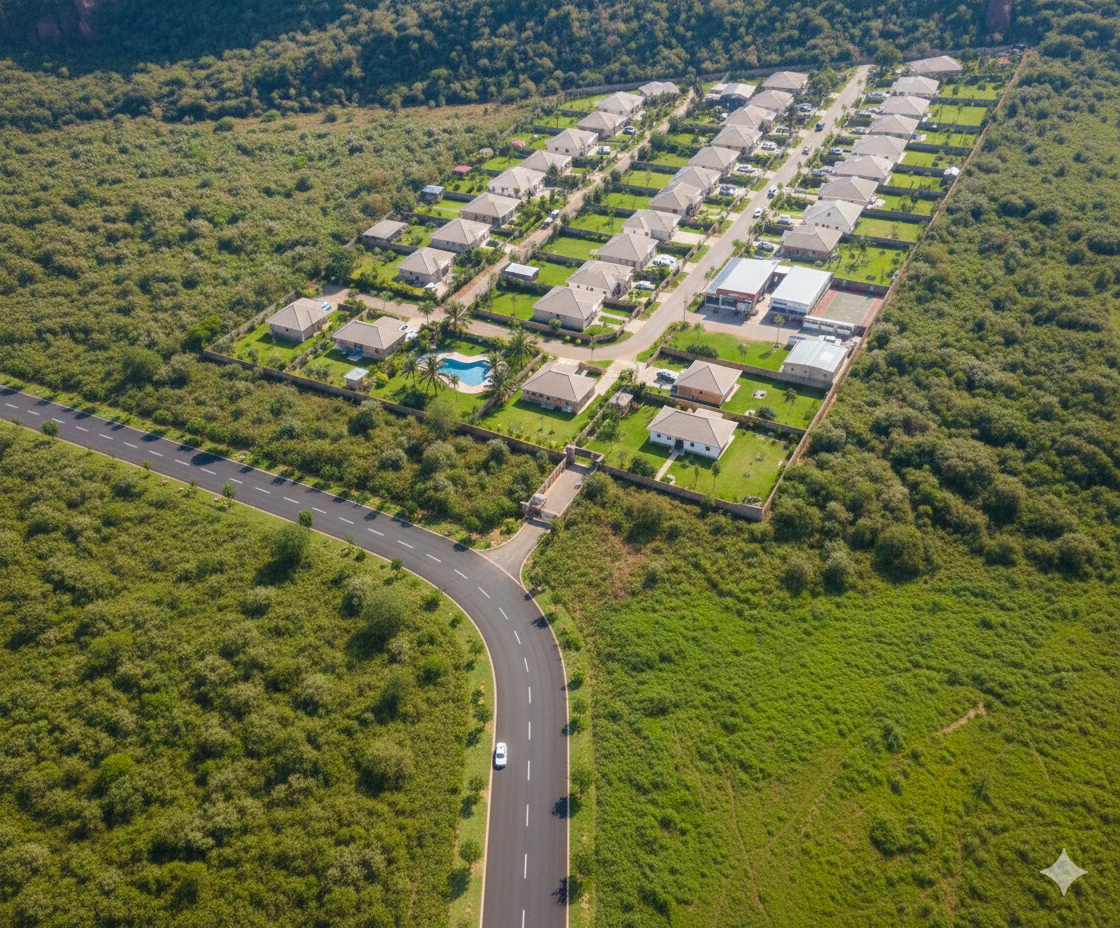
Ngong-Kimuka currently sits at the transition between Stage 3 and Stage 4—infrastructure has been completed (Southern Bypass, Ngong-Suswa Road), but pricing hasn’t fully caught up to the improved connectivity.
Completed Infrastructure:
- Southern Bypass: Reduced CBD commute from 90+ minutes to 35-45 minutes
- Ngong-Suswa Road: Improved accessibility from Nairobi’s southwest
- Electricity: KPLC infrastructure extended throughout the area
- Water: Piped water available, multiple boreholes viable
Coming Infrastructure (Value Catalysts):
- Ngong-Kibiku-Ruiru Road: Proposed connection improving east-west transit
- Commercial centers: Several malls and shopping complexes are in planning
- Schools: Private academies expanding into the area
- Healthcare: Hospitals and clinics following population growth
This represents the optimal investment entry point: infrastructure complete (reducing risk) but pricing not yet fully reflecting improved access (preserving upside).
Infrastructure Risk vs. Opportunity
The key to successful land investment is distinguishing between:
High Risk: Betting on proposed infrastructure that may never materialize
- Promises of bypasses or rail that remain “planned” for decades
- Politicians announcing projects that lack funding
- Areas dependent on a single infrastructure project that could be cancelled
Low Risk: Investing where infrastructure is already complete or actively under construction
- Roads are already paved and open to traffic
- Utilities already extended to the area
- Visible construction activity and development momentum
Ngong-Kimuka falls firmly in the low-risk category—the infrastructure already exists. You’re not speculating on what might happen; you’re capitalizing on what has already happened but hasn’t fully reflected in pricing yet.
Key Insight: Infrastructure transforms land value more dramatically than any other factor. The highest returns come from investing after infrastructure is complete but before pricing fully adjusts—exactly where Ngong-Kimuka sits today.
Reason 10: Demographic Trends Create Unstoppable Demand

Kenya’s Population Explosion and What It Means for Land
Kenya’s population trajectory tells an unambiguous story about future land demand:
- 2000: 31 million people
- 2010: 41 million people (32% increase in one decade)
- 2020: 52 million people (27% increase)
- 2024: 54+ million people
- 2030 (projected): 65+ million people
This isn’t gradual growth—it’s exponential expansion. Every year, Kenya adds approximately 1 million new residents who need housing, schools, hospitals, and commercial spaces. All of these require land.
Urbanization Amplifies the Effect
Population growth alone would drive land demand, but urbanization multiplies the impact. Kenya’s urban population has grown from 15% in 1990 to over 28% in 2024, and projections suggest it will reach 35-40% by 2030.
Why this matters for land investors:
When someone moves from rural Kisumu to Nairobi, they don’t just need a place to live—they need urban infrastructure that consumes far more land per capita than rural living:
- Paved roads instead of dirt paths
- Shopping centers instead of village markets
- Schools with playgrounds and sports facilities
- Hospitals with parking and emergency access
- Office buildings for employment
This urban migration concentrates on a tiny fraction of Kenya’s total landmass. The Nairobi Metropolitan Area—representing less than 1% of Kenya’s land—houses over 10% of the population and generates approximately 60% of the national GDP. This concentration creates intense pressure on available land.
The Middle-Class Explosion
Perhaps most significant for land investors is Kenya’s rapidly expanding middle class. The African Development Bank estimates Kenya’s middle class (earning USD 2,000-20,000 annually) doubled between 2010 and 2020, and is projected to double again by 2030.
What middle-class growth means:
Middle-class families have purchasing power and specific demands:
- They reject slum housing and want proper homes with titles
- They prioritize proximity to good schools (driving suburban demand)
- They purchase vehicles, enabling longer commutes to affordable suburbs
- They aspire to homeownership rather than perpetual renting
- They’re willing to pay premiums for better locations
This creates a “demand staircase” effect:
- Bottom tier: Lower-income families push into affordable outer suburbs (Kitengela outskirts, Ruai)
- Middle tier: Middle-class families purchase in developing satellite towns (Ngong-Kimuka, Mlolongo)
- Top tier: Wealthy families buy in established suburbs (Runda, Karen, Westlands)
As the middle class expands, demand cascades through all tiers, pushing prices upward everywhere.
Youth Demographics: The Coming Wave
Kenya has one of the youngest populations globally—median age approximately 20 years. This creates a demographic wave:
- Millions of young Kenyans are entering prime homebuying age (25-35)
- They’re more educated than previous generations (higher earning potential)
- They’re digital natives comfortable with innovative financing (mobile money, digital mortgages)
- They’re geographically mobile and willing to live in satellite towns if value is good
Over the next decade, this youth cohort will drive enormous housing demand as they form families and seek homeownership.
The Investment Implication
These demographic trends are not subject to government policy changes, economic cycles, or market sentiment. They’re structural realities that unfold over decades, regardless of short-term disruptions.
Simple math:
- Kenya adds ~1 million people annually
- Average household size: 4 people
- New households annually: 250,000
- Each household eventually needs land/housing
- Available land near Nairobi: fixed and diminishing
The gap between growing demand and fixed supply can only be resolved through rising prices. This isn’t speculation—it’s mathematical certainty.
Key Insight: Demographic trends are slow-moving but unstoppable. Population growth, urbanization, and middle-class expansion create structural demand for land that will persist for decades, providing a reliable foundation for long-term appreciation.
Reason 11: Transaction Costs Are One-Time, Not Annual—A Hidden Advantage
The Illusion of “No-Fee” Investments

Money market funds and some bonds advertise “no transaction fees,” which sounds attractive. But this obscures how they actually extract value from investors: through annual management fees that compound against you year after year.
Typical Money Market Fund Cost Structure:
- Annual management fee: 1.0-1.5% of assets
- Custodial fees: 0.2-0.3% annually
- Other administrative charges: 0.1-0.2%
- Total annual drag: 1.3-2.0% of your investment
These “small” annual fees devastate long-term returns through reverse compounding:
Example: Ksh 1 million invested for 20 years at 12% gross returns
Without fees: Ksh 9.65 million
With 1.5% annual fees: Ksh 7.04 million
Wealth destroyed by fees: Ksh 2.61 million (27% of potential wealth)
The longer you hold, the more fees are extracted. After 30 years, that 1.5% annual fee reduces your final wealth by nearly 35%.
Land’s One-Time Cost Structure
Land operates differently. You pay transaction costs once at purchase, then incur minimal expenses during holding:
Purchase Costs (One-Time):
- Stamp duty: 4% of purchase price
- Legal fees: Approximately 1-2% of purchase price
- Agent commission (if used): 5-10% (negotiable)
- Total one-time cost: 10-16% of purchase price
Annual Holding Costs:
- Land rates: Ksh 500-2,000 per year (often under 0.1% of value)
- Optional security: Variable
- Total annual cost: Negligible
Sale Costs (One-Time):
- Agent commission: 5-10% of sale price (if used)
- Legal fees: 1-2% of sale price
The Compounding Mathematics
Let’s compare the total cost of ownership:
Scenario: Ksh 1 million investment held for 10 years
Money Market Fund:
- Annual fee: 1.5% of growing balance
- Year 1 fees: Ksh 15,000 (on Ksh 1M)
- Year 5 fees: Ksh 25,000 (on higher balance)
- Year 10 fees: Ksh 42,000 (on a much higher balance)
- Total fees paid over 10 years: Approximately Ksh 300,000-350,000
Land:
- Purchase costs: Ksh 100,000 (10% of Ksh 1M)
- 10 years of land rates: Ksh 20,000 total
- Sale costs: Ksh 50,000 (assuming value doubled and 5% commission on Ksh 2M)
- Total costs over 10 years: Approximately Ksh 170,000
Land costs less in absolute terms, and critically, costs don’t grow with asset appreciation (except final sale commission). Money market fees grow every year as your balance increases, creating an accelerating wealth extraction.
Why This Matters More Than You Think
The difference isn’t just about absolute costs—it’s about who benefits from compounding.
With annual-fee investments, the fund manager benefits from compounding (their fees grow as your balance grows)
With one-time-cost investments, you benefit from full compounding (100% of appreciation accrues to you after initial costs)
Over multi-decade horizons, this difference can represent 20-30% of your final wealth.
The Liquidity Trade-Off
Yes, selling land takes longer than selling shares (weeks vs. seconds). This illiquidity is land’s trade-off for its one-time cost structure.
But ask yourself: How often do you actually need instant liquidity?
For true long-term wealth building (retirement, children’s education, generational wealth), instant liquidity is irrelevant. What matters is maximum wealth accumulation over 10-30 years. Land’s one-time cost structure delivers this better than any annually-fee-based investment.
Key Insight: Annual fees appear small but compound devastatingly against you over decades. Land’s one-time transaction costs, while higher upfront, preserve your full compounding potential for superior long-term wealth accumulation.
Reason 12: Land Survives Economic Crises—Paper Assets Often Don’t

The Crisis Test: What Endures When Everything Collapses?
Economic crises separate resilient assets from fragile ones. History provides brutal lessons about which investments survive systemic shocks and which evaporate.
Historical Crisis Performance
2008 Global Financial Crisis:
- Stocks: Global equity markets fell 50-60%; many banks and companies went bankrupt
- Bonds: Corporate bonds of failed institutions became worthless; even government bonds in some countries restructured
- Real Estate: Property values in prime Kenyan locations declined 10-15% temporarily, then recovered within 18-24 months and continued appreciating
2020 COVID-19 Pandemic:
- Stocks: NSE All Share Index initially plummeted over 20% in March-April 2020
- Bonds: Yields spiked as investors fled to safety, reducing bond values temporarily
- Real Estate: According to HassConsult, land prices in satellite towns actually continued appreciating during 2020-2021, with Ngong gaining 6.5% annually even during lockdowns
2022-2023 Inflation Crisis:
- Stocks: Volatile performance as companies struggled with input costs
- Bonds: Real returns turned negative as inflation outpaced yields
- Real Estate: Land in satellite towns appreciated 11-16% annually, providing strong inflation hedge
Why Land Survives Crises Better
Fundamental Utility Persists: Regardless of economic conditions, people need places to live and work. Land’s fundamental utility doesn’t disappear during recessions—it might temporarily be less in demand, but it never becomes worthless.
Companies, by contrast, can see their entire business model destroyed by economic shifts. Kodak, Blockbuster, and countless other once-dominant firms went to zero when their industries changed.
No Leverage-Induced Forced Sales: During crises, margin calls force stock investors to liquidate at the worst possible moment. Land investors holding moderate leverage face no such pressure—banks don’t issue margin calls on land loans unless you default on payments.
Government Support for Real Estate: Governments worldwide support real estate during crises because housing stability is politically critical. Kenya, like most nations, implements policies during downturns to support property markets (lower interest rates, affordable housing initiatives, infrastructure spending). No such support exists for stock markets.
Physical Asset Cannot Be Devalued to Zero: A share certificate can become worthless overnight (company bankruptcy). Land cannot. Even in worst-case scenarios (war, natural disaster), land retains some value because the underlying physical asset persists.
The Recovery Pattern
Perhaps most important: Land recovers faster and more completely from crises than other assets.
Typical Crisis Recovery Timeline:
Stocks:
- Decline: 6-12 months
- Bottom: Often 40-60% below peak
- Recovery to previous peak: 3-7 years
- Many individual stocks never recover
Land (Prime Locations):
- Decline: Rare; usually just slower appreciation
- “Bottom”: Typically 10-20% below peak in absolute worst case
- Recovery to previous peak: 12-24 months
- Prime locations almost always exceed previous peaks within 2-3 years
HassConsult data confirms this: During every economic shock over the past 20 years, Nairobi satellite towns experienced at most temporary growth slowdowns, not actual value destruction, and recovered within 18-24 months.
Crisis as Opportunity
Savvy land investors actually welcome economic downturns as buying opportunities:
- 2009-2010: Post-financial crisis, investors who purchased land in emerging corridors saw 400-600% returns by 2020
- 2020-2021: COVID crisis created brief hesitation; investors who bought during uncertainty realized 100-200% gains by 2024
- 2023-2024: Inflation spike and high interest rates slowed market; creates current opportunity in Ngong-Kimuka
Crises create temporary fear that causes others to delay purchases. This allows strategic investors to acquire prime land at optimal pricing before markets normalize.
Key Insight: The question isn’t whether crises will occur—they’re inevitable. The question is which assets survive them. Land’s track record is unambiguous: it survives, recovers quickly, and often emerges stronger as economic recovery drives renewed demand.
Reason 13: Behavioral Advantages—Land Prevents Wealth-Destroying Mistakes
The Psychology of Investing: Where Most Investors Fail
Intellectually, successful investing is simple: Buy quality assets at fair prices, hold long-term, let compounding work. Emotionally, it’s incredibly difficult. Behavioral finance research shows that investor psychology destroys more wealth than poor asset selection.
Common Investor Mistakes:
- Panic selling during crashes: Locking in losses at market bottoms
- Chasing performance: Buying high after assets have already surged
- Over-trading: Generating excessive fees and taxes
- Emotional decision-making: Letting fear and greed override rational analysis
Studies show the average investor dramatically underperforms the markets they invest in—not because they choose bad investments, but because they make terrible timing decisions driven by emotion.
How Land’s Illiquidity Becomes an Advantage
Land’s greatest perceived weakness—illiquidity—is actually one of its strongest psychological advantages for long-term wealth building.
You Can’t Panic-Sell What Takes Weeks to Sell:
When stock markets crash 20% in a week, investors panic. They watch their portfolios drop thousands or millions in days. The temptation to “stop the bleeding” by selling becomes overwhelming. Within hours, they can execute trades that lock in massive losses.
Land doesn’t allow this. Even if you panic during a crisis, you cannot instantly sell. By the time you:
- List the property
- Find a buyer
- Negotiate terms
- Complete legal processes
…weeks or months have passed. The initial panic has subsided. Rational thinking returns. You likely don’t sell, avoiding a catastrophic wealth-destroying decision.
The “Out of Sight, Out of Mind” Effect:
Stock portfolios update in real-time. Investors check balances daily, watching every fluctuation. This constant monitoring creates emotional volatility that drives poor decisions.
Land doesn’t have a ticker price updating every second. You don’t see its value dropping 2% today, recovering 1.5% tomorrow, falling 3% next week. This absence of constant price feedback prevents the emotional roller coaster that causes wealth-destroying trades.
Many land investors don’t even think about their land for months or years at a time. This benign neglect is actually optimal investment behavior—it allows compounding to work without emotional interference.
Forced Long-Term Thinking:
Land’s transaction costs (stamp duty, legal fees, agent commissions) make short-term trading economically irrational. You wouldn’t buy land and sell six months later—you’d lose money to transaction costs.
This forces long-term holding, which is exactly what builds wealth. Stock traders think in days or weeks. Land investors think in years or decades. This time horizon difference fundamentally changes outcomes.
The Commitment Mechanism
Behavioral economists recognize that “commitment mechanisms”—structures that prevent you from making impulsive decisions—improve long-term outcomes.
Examples:
- Retirement accounts with penalties for early withdrawal: Force long-term saving
- Fixed-term deposits: Prevent impulsive spending
- Land investment: Creates a natural commitment to long-term holding
Land’s illiquidity functions as a wealth-building commitment mechanism. It prevents the impulsive, emotion-driven decisions that destroy wealth in liquid markets.
The Social Proof Effect
Owning shares is abstract. Owning land is tangible. This creates different social dynamics:
Shares:
- Nobody sees them
- You feel no pride of ownership
- Easy to sell when stressed
- No community perception
Land:
- Visible, physical asset
- Pride of ownership
- The community knows you own it
- Selling feels like admitting defeat
This social dimension creates additional psychological barriers to panic selling, further protecting your wealth during stressful periods.
Key Insight: The greatest threat to your wealth isn’t market volatility—it’s your own emotional reactions to volatility. Land’s illiquidity isn’t a bug; it’s a feature that protects you from yourself, preventing the panic-driven decisions that destroy wealth in liquid markets.
Reason 14: Ngong-Kimuka Embodies All These Principles—Here’s Your Entry Point
The Convergence of Every Advantage
We’ve examined thirteen reasons why strategically located land outperforms bonds, money markets, and shares. Ngong-Kimuka represents the practical application of every single principle:
✓ Superior Returns (Reason 1): Historical satellite town data shows 11-16% annual appreciation; Ngong-Kimuka’s infrastructure completion positions it for this trajectory
✓ Low Volatility (Reason 2): Land prices in the corridor have shown consistent quarterly appreciation of 2-4% with minimal volatility
✓ Inflation Hedge (Reason 3): Real assets in infrastructure-supported corridors consistently beat inflation by 5-10 percentage points annually
✓ Zero Counterparty Risk (Reason 4): Clean, verified titles with comprehensive legal due diligence eliminate institutional risk
✓ Scarcity Value (Reason 5): Ngong-Kimuka sits in Nairobi’s natural westward expansion path with limited developable land remaining
✓ Tax Efficiency (Reason 6): Appreciation compounds tax-free; only stamp duty at purchase, then negligible annual costs
✓ Leverage Potential (Reason 7): Banks readily finance 70-80% of purchases in this established corridor
✓ Multiple Exit Strategies (Reason 8): Can sell, develop, joint venture, borrow against, or hold for heirs
✓ Infrastructure Complete (Reason 9): Southern Bypass and Ngong-Suswa Road finished, yet pricing hasn’t fully adjusted
✓ Demographic Tailwinds (Reason 10): Directly in path of Nairobi’s middle-class expansion seeking affordable suburbs
✓ One-Time Costs (Reason 11): No annual fees eroding returns; transaction costs paid once, then full appreciation accrues to you
✓ Crisis Resilient (Reason 12): Prime corridors near Nairobi have weathered every economic shock with minimal impact
✓ Behavioral Advantages (Reason 13): Illiquidity prevents panic selling and forces wealth-building long-term holding
The Current Market Opportunity
Pricing Context:
- Ngong-Kimuka current: Ksh 900,000 – 1.5 million for 50×100 plots (Ksh 5-9 million per acre equivalent)
- Comparable developed areas:
- Ongata Rongai: Ksh 27.4 million per acre (3-5x current Ngong-Kimuka pricing)
- Syokimau: Ksh 33.7 million per acre (4-6x current pricing)
- Ngong town center: Ksh 8.13 million average plot (similar pricing to Kimuka)
- Established Nairobi suburbs: Ksh 80-200 million per acre (10-40x current pricing)
The Value Proposition:
You’re purchasing land with comparable infrastructure access to areas commanding 3-6x higher prices, at a stage when most appreciation is still ahead.
The 5-7 Year Projection

Based on historical patterns of satellite towns at similar development stages, conservative projections for Ngong-Kimuka:
Conservative Scenario (11% annual appreciation):
- Purchase: Ksh 1.2 million today
- 7 years: Ksh 2.5 million
- Return: 108%
Base Case Scenario (15% annual appreciation):
- Purchase: Ksh 1.2 million today
- 7 years: Ksh 3.3 million
- Return: 175%
Optimistic Scenario (20% annual appreciation matching early Syokimau):
- Purchase: Ksh 1.2 million today
- 7 years: Ksh 4.3 million
- Return: 258%
These aren’t speculative fantasies—they mirror the actual documented appreciation of Ongata Rongai, Syokimau, and Mlolongo over their past 7-10 years of development.
Why Act Now: The Window is Closing
Several factors suggest current pricing represents a brief opportunity:
1. Infrastructure Pricing Lag: The Southern Bypass opened in phases through 2022-2023. Market pricing is still catching up to the dramatically improved connectivity. This lag typically lasts 18-36 months before pricing fully adjusts.
2. Institutional Interest Increasing: Larger developers are beginning site reconnaissance in Ngong-Kimuka. Once institutional capital enters, land prices jump 30-50% as developers purchase large parcels.
3. Master Developments Launching: Several organized developments are in planning/early phases. These create “anchor” effects that raise surrounding land values 20-40%.
4. Interest Rate Normalization: As rates moderate from 2024 highs, mortgage accessibility improves, driving demand from middle-class homebuyers.
5. Best Plots Selling First: Prime locations near key roads, amenities, and elevated areas sell first to informed buyers. Delaying often means settling for inferior locations at similar or higher prices.
The Wilper Ventures Advantage
When you invest through Wilper Ventures in Ngong-Kimuka, you receive:
✓ Verified Clean Titles: Every parcel undergoes comprehensive title searches, verification of boundaries, and legal clearance before offering
✓ Strategic Location Selection: We identify plots near key infrastructure, future development nodes, and high-appreciation corridors
✓ Flexible Payment Plans: Structured to make entry accessible across various investor budgets—from lump sum to installment options
✓ Ongoing Support: From purchase through holding to eventual sale/development, we provide guidance and support
✓ Transparent Pricing: No hidden fees; clear documentation of all costs upfront
✓ Site Visit Facilitation: Arranged tours to see your investment and surrounding development firsthand
Take the Next Step
The data support the opportunity. The infrastructure is in place. The demographic trends are undeniable. The pricing remains accessible. The time to act is now.
Contact Wilper Ventures today:
📍 Website: wilperventures.com
📞 Phone: +254 114 333 888
📧 Email: sales@wilperventures.com
🏢 Office: Uptown Mall, Ngong, Kenya
Schedule a consultation to discuss:
- Current inventory in Ngong-Kimuka
- Payment plan options tailored to your budget
- Site visit scheduling
- Legal process and timeline
- Long-term investment strategy
Secure your position in one of Nairobi’s fastest-growing corridors before institutional capital enters and pricing adjusts upward.
Conclusion: The Wealth-Building Path Forward
We’ve examined fourteen data-driven reasons why strategically located land outperforms bonds, money markets, and shares. The evidence isn’t anecdotal—it comes from decades of documented performance data from HassConsult, Central Bank of Kenya, NSE, and Kenya National Bureau of Statistics.
The Core Reality:
While bonds struggle to beat inflation after taxes, money markets deliver barely positive real returns, and stocks subject investors to gut-wrenching volatility, prime land in emerging corridors has consistently delivered 200-400% returns over 5-7 year periods with minimal volatility and virtually zero counterparty risk.
This isn’t too good to be true—it’s the inevitable result of fixed supply meeting growing demand, amplified by infrastructure development, demographic expansion, and tax-advantaged compounding.
The Ngong-Kimuka Opportunity:
Just as early investors in Syokimau, Rongai, and Ruiru built generational wealth by recognizing potential before widespread market recognition, today’s Ngong-Kimuka investment represents tomorrow’s success story.
The infrastructure is complete. The pricing hasn’t fully adjusted. The demographic wave is building. The window is open—but closing.
Two Choices:
- Wait for “perfect” timing (which never arrives) and watch as others recognize the opportunity, driving prices beyond your reach
- Act strategically now, securing prime land at today’s pricing and positioning yourself for the appreciation that historical data says is coming
History rewards those who recognize opportunity while others hesitate.
The question isn’t whether land in prime corridors will appreciate—it’s whether you’ll be positioned to benefit when it does.
Sources & Data References
- HassConsult Property Index Reports (Q1-Q2 2024): Land price appreciation data for Nairobi suburbs and satellite towns
- Nairobi Securities Exchange: Stock market performance data (NSE 20, NSE All Share Index)
- Central Bank of Kenya: Government bond yields, Treasury bill rates, inflation data
- Trading Economics: Kenya economic indicators and government bond yields
- Vasili Africa & Capital Markets Authority: Money market fund performance rankings
- Kenya National Bureau of Statistics: Consumer Price Index, inflation rates, population data
- Ministry of Lands: Land transaction records and valuation data
Published by Wilper Ventures Limited | January 2026
For inquiries: sales@wilperventures.com | +254 114 333 888
Ready to invest in Ngong-Kimuka? Visit wilperventures.com or call us today to schedule your site visit and secure your plot before prices adjust upward.


Join The Discussion