

When Kenyans talk about buying land, the phrase that comes up most often is simple: “Does it have a title deed?”
And it makes sense. The title deed is the document most people associate with land ownership. It has your name on it. It looks official. It feels like proof.
But here is something that thousands of buyers — including educated, experienced people — discover too late: a title deed alone is not enough to confirm that a piece of land is legally yours, free of disputes, or safe to buy.
There is another document that sits above the title deed in legal authority. It predates the title deed, outlives it, and contains information the title deed will never show you. It is the document that courts turn to when titles are disputed — and it is the document that can confirm, or completely unravel, what a title deed appears to say.
It is called the Green Card.

If you have never heard of it, you are not alone. Most buyers haven’t. But by the time you finish reading this guide, you will understand exactly what the Green Card is, how it differs from a title deed, why both documents matter, and what you should always do before buying any piece of land in Kenya.
Part 1: The Title Deed — What It Is and What It Does
What is a Title Deed?
A title deed is the official government-issued document that confirms who currently owns a specific parcel of land in Kenya. It is issued by the Ministry of Lands and Physical Planning and is registered under the Land Registration Act, 2012 — the law that currently governs land ownership in Kenya.
Think of the title deed as your identity card for the land. Just as a national ID confirms who you are as a person, the title deed confirms who owns a particular piece of land at a specific point in time.
When a land transaction is completed — when someone buys land, inherits it through succession, or receives it as a gift — the title deed is updated or reissued to reflect the new owner. The person walking away from the transaction holds the title deed in their name.
What Information Does a Title Deed Contain?
A standard title deed in Kenya contains the following:
- The title number (the unique identifier for that specific parcel of land)
- The name of the current registered owner
- The land reference number (LR number), which identifies the parcel in the national land registry
- The size of the land (acreage or square metres)
- The location of the land (county, district, division)
- The nature of ownership — freehold or leasehold
- For leasehold titles: the lease period (e.g., 99 years), the commencement date, and the ground rent payable
- The date of issue and the signatures of the relevant land registrar
Types of Title Deeds in Kenya
Kenya recognises several types of title deeds, reflecting the country’s history of different land registration laws:
1. Freehold Title Deed (Absolute Title) This is the most powerful form of ownership. A freehold title gives
you permanent, unlimited ownership of the land — with no time restriction, no rent payable to the
government, and the broadest possible rights to use, develop, and transfer the land. Most private
residential plots in peri-urban areas like Ngong and Kimuka are sold on freehold titles.
2. Leasehold Title Deed (Certificate of Lease) Here, the government (through the National Land
Commission) retains ultimate ownership of the land and leases it to you for a defined period —
typically 33, 50, or 99 years. Urban land, especially in Nairobi’s commercial zones, is frequently held
under leasehold. You pay annual ground rent and must comply with the terms of the lease. At the
expiry of the lease, you can apply for renewal — but it is not automatic.
Important: All 999-year leases in Kenya were automatically converted to 99-year leases when the 2010
Constitution came into effect. If you own or are buying land with a 999-year leasehold title,
understand that it is legally treated as 99 years.
3. Sectional Title Deed This applies to individual units within a larger building — apartments, flats, or
offices within a development. Each unit owner holds a sectional title deed confirming ownership of
their specific unit, while common areas (lifts, lobby, parking) are shared.
What Does a Title Deed Prove — and What Doesn’t It Prove?
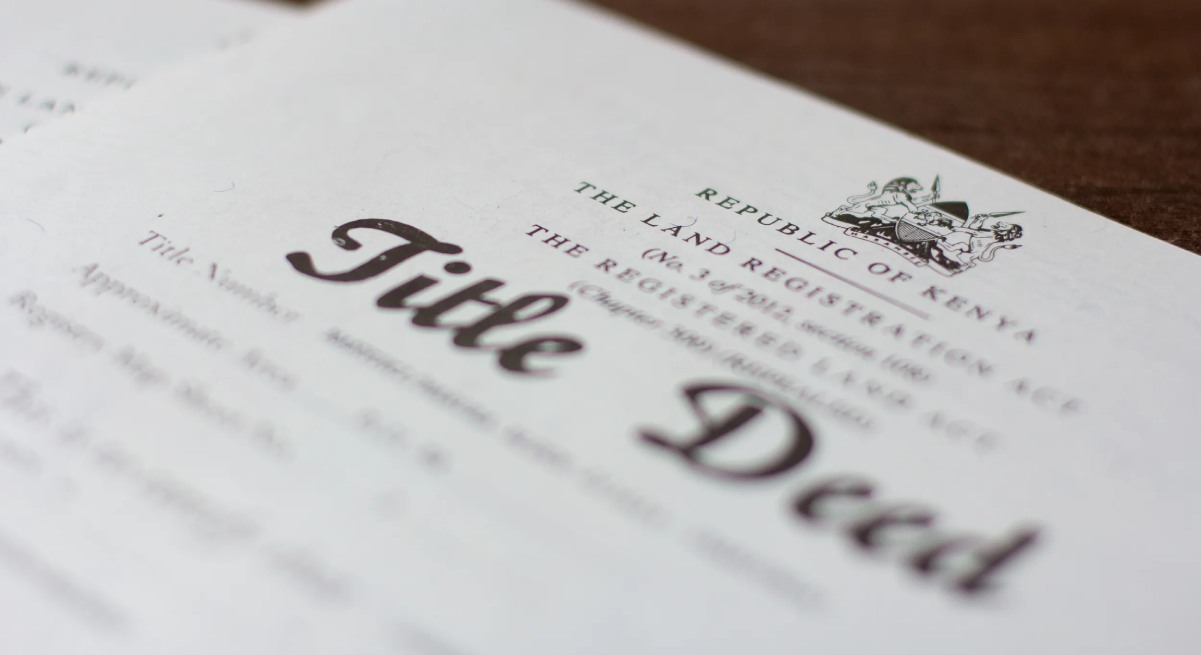
This is the crucial part that most buyers misunderstand.
A title deed proves who is currently registered as the owner of a piece of land. It does not, by itself, prove:
- That the land was legally allocated in the first place
- That the previous transfers were conducted lawfully
- Whether there are active charges, mortgages, or caveats on the land
- Whether there are ongoing disputes or court orders involving the land
- Whether the title has ever been cancelled, replaced, or altered
- Whether the same land has been fraudulently sold to multiple buyers
A title deed is only as strong as the history behind it. And that history lives somewhere else entirely.
Part 2: The Green Card — Kenya’s Master Land Record
What is a Green Card?
The Green Card is the official master record for a parcel of land, maintained at the Ministry of Lands and Physical Planning (and the relevant county land registry). It is the foundational document from which the title deed is derived.
While the title deed tells you who owns the land today, the Green Card tells you everything that has ever happened to that land — from the moment it was first registered to the most recent transaction. It is the complete, unbroken story of a parcel of land, written in chronological order.
Why “Green Card”? The original documents were printed on green paper — hence the name. Today, certified copies issued by the Ministry of Lands are usually printed on white paper, but the name has stuck. Do not confuse this with the American immigration document of the same name — this is entirely different.
The Green Card is not given to landowners. It stays permanently at the Land Registry. You cannot take it home. What you can do — through a licensed advocate or surveyor, or as the property owner yourself — is request a certified copy or conduct a formal search against it.
What Information Does a Green Card Contain?
The Green Card is divided into three distinct sections, each capturing a different layer of information about the parcel:
Section 1: The Property Section. This records the physical details of the land:
- The title number and LR (land reference) number
- The size of the parcel (in acres or hectares)
- The boundaries and the map sheet number (which references the survey plan)
- Whether the land is near or within a protected zone, road reserve, riparian area, or government reservation
- Any subdivisions that have taken place — including the original “mother title” and the resulting sub-parcels
Section 2: The Proprietorship Section This is the ownership history — the part most buyers want to see:
- The names of every person or entity that has ever been registered as the owner of this land
- The date each person became the registered owner
- How ownership was acquired each time (purchase, succession, court order, government allocation, gift)
This section creates an unbroken chain of title going all the way back to the land’s original registration. If someone claims to own land that was actually registered in another person’s name — or if ownership was transferred without following proper legal processes — the Proprietorship section will reveal it.
Section 3: The Encumbrances Section. This is arguably the most important section for any buyer:
- All charges on the land (mortgages or loans for which the land was used as collateral)
- All caveats (legal notices warning that someone has a claim on the land)
- All restrictions (limitations on how the land can be transferred or developed)
- Court injunctions or orders relating to the land
- Any discharges — formal confirmations that a previous charge or caveat has been lifted
This section answers the question: Is this land legally clean and free to be sold? A title deed will not show you any of this in real time. The Green Card will.
Part 3: Green Card vs. Title Deed.
| Feature | Title Deed | Green Card |
|---|---|---|
| What it is | Certificate of current ownership | Only accessible by the owner, advocate, or licensed surveyor |
| Who holds it | The registered owner | Permanently at the Land Registry |
| What it shows | Current owner, land size, location | Full ownership history, all transactions, encumbrances |
| Legal authority | Proof of current registration | The source document from which titles are issued |
| Can it be forged? | Yes — forgeries exist and are common | Much harder — it is the official registry record |
| Shows encumbrances? | No (not in real time) | Yes — all charges, caveats, and restrictions |
| Shows previous owners? | No | Yes — every owner since first registration |
| Shows subdivisions? | No | Yes — mother title and all sub-parcels |
| Access | Held by the owner | Only accessible by owner, advocate, or licensed surveyor |
| Cost to search | ~Ksh 500 (online via Ardhisasa) | ~Ksh 2,500 (at the Land Registry) |
| Issued by | Ministry of Lands | Ministry of Lands (never leaves the registry) |
Part 4: Why the Green Card Matters More Than Most People Realise
1. Title Deeds Can Be Forged. The Green Card Is the Authority.
Land fraud in Kenya is a significant and well-documented problem. Sophisticated fraudsters are capable of producing convincing fake title deeds — complete with stamps, signatures, and official-looking paper. A buyer who relies only on a visual inspection of a title deed is exposed to this risk.
The Green Card, by contrast, is the official source record. It lives at the Land Registry and cannot be taken away, altered, or replaced without going through formal legal channels that leave a paper trail. When in doubt, the details on a title deed must match the Green Card exactly. If they do not — different owner name, different parcel size, different history — that is an immediate red flag requiring urgent legal attention.
2. The Green Card Reveals the Root of Title
In a landmark 2023 Supreme Court ruling — Dina Management Ltd v County Government of Mombasa & 5 others — the court affirmed something important: holding a title deed does not automatically mean you lawfully own the land if the original allocation was unlawful. Even an innocent buyer who paid full market value could lose the land if the root of title — the original government allocation — was irregular or fraudulent.
The Green Card is the primary tool for verifying the root of title. It takes you back to the very beginning — the first registration of the land — and allows you to trace every subsequent transaction to confirm that each one was lawful.
Buying land without checking the Green Card means buying without understanding whether the very foundation of the title is sound.
3. The Green Card Shows What the Title Deed Won’t
Consider this scenario: a seller offers you a plot. The title deed is in their name. It looks clean. The land search shows they are the registered owner. You pay. You take the title deed.
What you may not have checked: the Green Card reveals that two years ago, the seller took a Ksh 2 million bank loan using the land as collateral. The bank registered a charge — a legal claim on the land — in the Green Card’s Encumbrances section. The loan has not been repaid. The bank’s charge is still active.
You now own land with an active bank charge against it. The bank can pursue that charge. Your title deed gave you no warning.
This is not a hypothetical. It happens. The Encumbrances section of the Green Card is the only reliable way to confirm that a piece of land is completely free of financial or legal claims before you buy.
4. The Green Card Protects Against Double-Selling
Another known fraud in Kenya involves sellers who sell the same plot to multiple buyers — each of whom receives a copy of the title deed and believes they are the only buyer. This is especially prevalent in informal sales where agreements are handwritten, and lawyers are not involved.
The Green Card records every registered transaction chronologically. A properly conducted Green Card search, done through official channels at the Land Registry, will reveal if ownership has been transferred to someone else before you complete your purchase.
5. The Green Card Tracks Subdivisions
When a large parcel of land is subdivided into smaller plots — as is the case with most land developments, including residential plot projects — each sub-parcel gets its own new title deed. But the original parcel — the mother title — is recorded in the Green Card.
This matters for buyers because: if the subdivision was not done legally, if the survey was not approved, or if the mother title had encumbrances that were not cleared before subdivision, all the child titles (and your plot) could be legally compromised.
A Green Card search on the original parcel — before buying a subdivided plot — confirms that the subdivision was done correctly and that the titles being sold are clean.
Part 5: What Actually Happens During a Land Search
When you or your advocate conducts a land search in Kenya, here is what actually happens — and what kind of search you are doing:
The Standard Title Search (Ksh 500 via Ardhisasa)
This is the most basic search — done online through the government’s Ardhisasa platform (ardhisasa.lands.go.ke) or at the local Huduma Centre. It confirms the registered owner’s name, the parcel number, and flags any obvious encumbrances currently on record digitally.
This is a useful starting point, but it is not the same as a Green Card search. The digital system is still being populated, and not all historical information has been transferred online.
The Green Card Search (Ksh 2,500 at the Land Registry)
This is the deeper, more authoritative search. It is conducted physically at the specific Land Registry where the parcel is registered. Your advocate or a licensed surveyor requests access to the Green Card and produces a certified extract.
This search gives you:
- The complete ownership history
- All encumbrances, charges, caveats, and restrictions — including historical ones
- Confirmation that the title deed in front of you matches the official registry record
- Visibility of any court orders or other legal actions involving the land
For any significant land purchase, this search is non-negotiable.
Note: Only the property owner, a licensed advocate, or a licensed surveyor can access the Green Card at the Land Registry. As a buyer, always instruct your advocate to conduct this search before you sign any sale agreement or pay any money.
Part 6: Red Flags — When the Green Card and Title Deed Don’t Match
If you conduct a Green Card search and discover any of the following, stop and consult a lawyer before proceeding:
- Different owner name. The Green Card shows a different person as the registered owner than the person trying to sell you the land. This is a serious red flag.
- Active charges or caveats. The Encumbrances section shows an undischarged bank loan, a court caveat, or a legal restriction that the seller did not disclose.
- Missing transactions. There is a gap in the chain of ownership that cannot be explained, suggesting a transaction may have been done outside the proper legal process.
- Irregular subdivision. The sub-parcel you are buying does not appear in the Green Card as a properly registered child of the mother title.
- Court orders. There is a court order or injunction relating to the land that could prevent its transfer.
- Different parcel size. The size shown on the Green Card is different from what is shown on the title deed. This could indicate a surveying irregularity or tampering.
Any one of these warrants immediate legal advice and, in most cases, walking away from the transaction until the issue is resolved.
Part 7: Due Diligence Checklist Before Buying Land in Kenya
Use this as your non-negotiable checklist before committing to any land purchase:
- Conduct a standard title search via Ardhisasa (Ksh 500) to confirm basic ownership details
- Engage a licensed advocate registered with the Law Society of Kenya
- Instruct your advocate to conduct a full Green Card search at the Land Registry (Ksh 2,500)
- Confirm the owner’s name on the title deed matches the Green Card exactly
- Confirm there are no active charges, caveats, or restrictions in the Encumbrances section
- Confirm the size of the land matches between the title deed, the Green Card, and the survey plan
- Request the survey plan from the seller and verify it against the Registry Index Map (RIM)
- Physically visit the site to confirm the beacons (boundary markers) are in place
- If the land is a subdivision, conduct a Green Card search on the mother title as well
- Confirm that land rates and land rent (where applicable) are fully paid — get clearance certificates
- Check whether the land falls in a protected zone, road reserve, or riparian area
- Do not sign any agreement or pay any deposit until your advocate gives clearance
The Bottom Line
The title deed and the Green Card are not competing documents — they work together. The title deed is what you hold as the owner. The Green Card is what the government holds as the official record. Both must tell the same story.
When they do — when the title deed matches the Green Card, the encumbrances section is clean, the ownership chain is unbroken, and the physical land matches the survey — you have a safe, legally sound transaction.
When they don’t — even in small ways — you could be walking into a dispute, a fraud, or a legal battle that costs far more than the land itself was ever worth.
The most expensive piece of land in Kenya is not the one with the highest asking price. It is the one bought without proper due diligence.
Always check the title deed. Always check the Green Card. Always use a lawyer.
At Wilper Ventures, every plot we sell comes with a clean title deed that has been fully verified — including a Green Card search confirming clear ownership history and no encumbrances. We believe that buying land should be a safe, transparent process, and we are committed to giving our buyers the confidence and documentation they deserve.
📞 +254 114 333 888
✉️ info@wilperventures.com
🌐 wilperventures.com
Disclaimer: This article is intended for general informational purposes only and does not constitute legal advice. Land laws and registration procedures may be updated from time to time. For advice specific to your situation, please consult a licensed advocate registered with the Law Society of Kenya.


Join The Discussion